Blog/Article
The Importance of Team Alignment: Why Execution Stalls
Execution stalls when decisions live in your head and your chat history. How to spot a misaligned team, trace where alignment breaks, and fix it with a decisions log your team actually uses.
- Written by
- Amy Khafash
- Published
- February 10, 2026
- Read
- Execution · 11 min read

The importance of team alignment comes down to this: misalignment, not a lack of talent or tooling, is why execution stalls and every decision routes through you. When priorities, handoffs and decisions live only in your head or your chat history, nobody can pick up a task without a full briefing from you. Fix the alignment failure and the founder bottleneck loosens.
Key takeaways
Alignment is three answers
Everyone can say what was decided, why, and what their desk does next, without asking the founder.
It is a memory problem
When the reasoning behind decisions dies in chat threads and AI chats, execution stalls.
The symptoms repeat
Re-explained projects, stalled handoffs and priorities that shift between meetings.
Trace before you fix
Follow one handoff, one decision and one recurring meeting from the last two weeks.
The fix is a record
A decisions log that captures the why and the rejected options, used as the place work starts.
What does team alignment actually mean?
Team alignment means every person on your team can answer three questions without asking you: what was decided, why it was decided, and what their desk does next. In a 2 to 20 person company, that is the whole job. Alignment is not a meeting you hold. It is a shared record of decisions and handoffs that stays accurate after the conversation ends.
Alignment is not agreement
Your team can like each other, nod in the all-hands, and still build the wrong thing. Agreement is a feeling in the room. Alignment is whether the follow-through matches the decision two weeks later, when nobody remembers which approach won.
Alignment is a memory problem, not a vibes problem
Most small teams lose alignment because the reasoning dies in chat threads and AI conversations. Founders often describe the same thing: much of the "why" behind a project ends up inside AI chats, including what got cut, what was tried and dropped, and which approach won. That is why alignment starts as a memory layer, and why the decisions log comes before the workflow chart.
Agreement is a feeling in the room. Alignment is what still matches two weeks later.
If your leadership team is the layer that is drifting, on goals, priorities or who gets to decide, start with our companion piece, Leadership team alignment: diagnose the failure mode. This article covers the layer below it: how decisions survive the handoff to the people doing the work.
Why is team alignment important for execution?
In a 2 to 20 person company, execution speed depends on one thing: how quickly a decision becomes something someone else can act on without you explaining it again. When alignment is intact, a handoff carries the "why" with it. When it isn't, every task routes back through the founder, and the founder becomes the bottleneck.
The founder as the only place decisions get resolved
Most stalled execution isn't a talent problem. It's that decisions live in your head, your DMs and last Tuesday's call, so nobody else can resolve a question without asking you. That's why founder-led sales works until it doesn't: the playbook exists, but nobody else can run it. Alignment means the reasoning behind each decision is written down where the team can find it, so repeatable work stops depending on you.
Why more tools make it worse
Each new app adds another place context can hide. If you're drowning in tools, the problem isn't coverage. It's that no single surface holds what was decided and why. One shared memory for strategy, decisions and handoffs, the idea behind how Workspace supports marketing teams, beats another disconnected subscription.
What are the symptoms of a misaligned team?
Misalignment shows up as repeatable patterns, not vague "communication issues." You walk the same person through the same project three times, handoffs stall until you chase them, and priorities quietly change between Monday's standup and Wednesday's call. The founder bottleneck sounds the same everywhere: one person writes every post, takes every sales call and runs every demo, until nobody else can.
| Symptom | What it looks like | What it costs you |
|---|---|---|
| Re-explaining projects | Same context repeated to each person | Hours per week |
| Stalled handoffs | Tasks wait on your follow-up | Slower delivery |
| Shifting priorities | Work ordered differently each meeting | Wasted builds |
| Decisions in chat | The "why" buried in DMs or AI chats | Repeated debates |
What causes teams to fall out of alignment?
Decisions that die in chat history
The reasoning behind a project ends up inside AI chats and DMs. When that context never leaves the thread, the next person picks up the task with no record of what was decided or what was already ruled out. Alignment decays because the decision trail does.
Founder-dependent knowledge
When the founder is the default answer for every prospect question, pricing exception and campaign call, nobody else learns how those calls get made. The knowledge exists, but only in one head. Until you convert founder knowledge into organizational knowledge, every handoff routes back through you, and you become the bottleneck you are trying to escape.
Tool sprawl without a memory layer
Most small teams use plenty of tools, and each one holds a fragment of the truth. None of them records the decision and carries it to the desks that need it. Workspace treats strategy as active data: when leadership updates a priority, the change reaches every campaign and handoff that depends on it instead of dying in a chat.
How do you diagnose where alignment breaks down?
Pick three artifacts from the last two weeks: one handoff, one decision, one recurring meeting. Trace each one end to end and mark the exact spot where context stopped moving. Most founders find the break in the same place every time.
Three traces, about an hour
Step 01
Trace a handoff
Pick a task you handed off recently. Write down what the other person actually needed to know versus what they were told. If you had to walk them back through it in a call or a team chat thread, the handoff failed, not the person. The "why" lived in your head, so the task came back to you.
Step 02
Trace a decision
Take one real decision and find where it's recorded. If the reasoning, the options you rejected and the follow-ups live only in an AI chat or a DM, the decision is already half dead. Ask who keeps that record current and what happens when nobody does. A decision that can't be retrieved can't be repeated without you.
Step 03
Trace a meeting
Audit one recurring meeting: what decision did it produce, and where did that decision go afterward? If the answer is "notes nobody opened," the meeting is producing alignment theater. If the trail is scattered across six apps, that scatter is itself a finding.
Run all three traces and you'll have a map of where alignment breaks: handoffs that skip context, decisions that die in chat history, and meetings that don't feed anything downstream. Fix the break points first. Choosing or consolidating tools comes after, once you know which gap you are actually closing. The first symptom you notice is often not the real break, a pattern we unpack in The problem you see isn't always the problem you have.
How do you realign a team without another all-hands meeting?
At 2 to 20 people, alignment problems get fixed with records, not rituals. Three fixes work: a decisions log anyone can read, written reasoning behind each call, and strategy stored as active data instead of trapped in your head or a chat thread.
Write the why, not just the what
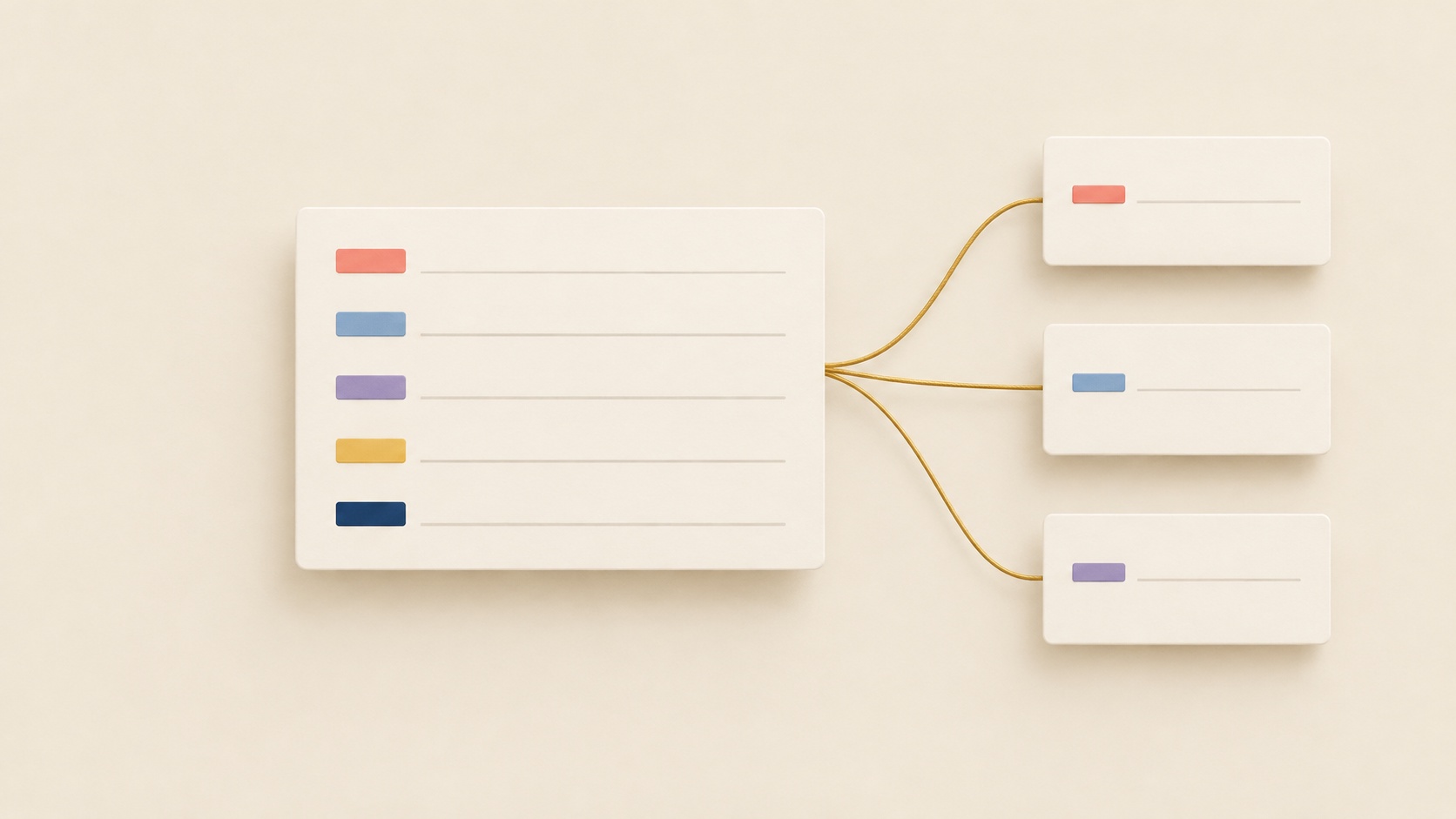
Most teams record what was decided and skip why. Then a handoff stalls because the person picking up the task never learned what was ruled out or what was tried first. A decisions log with two extra lines per entry, the reasoning and the rejected options, fixes that. It takes minutes and removes the repeat briefings that eat your week.
Here is what that looks like in practice. You decide to pause the podcast experiment and put those hours into outbound.
Six weeks later, a teammate picking up content planning can read that entry and know exactly why the podcast is off the roadmap, without booking you for a call. Multiply that by every decision you make in a month and the repeat-yourself tax disappears. The pattern is the same for every entry: decision, reasoning, rejected options, owner, review date.
Make the record the source, not the founder
If the log lives in a doc nobody opens, you stay the bottleneck. The record has to be the place work starts: priorities, campaign context and prospect criteria all read from the same source. When someone asks "what was decided," the answer points to the log, not to you. That is what makes execution repeatable without the founder in the loop. For more on handing what you know to the team, see how Workspace supports founders.
How do you keep alignment from decaying over time?
Alignment rots quietly: the strategy changes, the shared record doesn't, and three weeks later someone executes against a dead priority. The fix is a closed loop. When a decision changes, update the decisions log the same day, and make sure the update reaches every desk that worked from the old version.
A quarterly "without the founder" test
Once a quarter, hand one real task to someone who wasn't in the original conversation. If they need you to walk them through the project, the "why" is still trapped in your head or your chat history. Log the gap, fix the record, and run the test again next quarter.
How do strategy tools handle alignment?
Most alignment tools stop at tracking. Enterprise planning platforms and dashboard software give you views of goals and KPIs, and scorecard apps keep score. They tell you whether the numbers moved, not why a decision was made or what was dropped along the way.
Run any tool through the same four tests:
- Does strategy stay active data, or freeze in a document?
- Does the reasoning behind decisions survive the handoff?
- Can someone else pick up a task without a briefing from you?
- How fast can leadership update direction for every desk?
Workspace is built for that loop. Strategy feeds campaign narrative, collateral and prospect criteria. ALEX, the Business Brain, answers from your own company records, so answers point back to evidence. When leadership updates the Brain, every desk works from the change, including your sales team. The honest trade-off: it assumes you want strategy and execution in one place, not a dashboard bolted onto your existing stack.
FAQ
Start with your last three handoffs
This week, pick the last three tasks you handed off. For each one, write down whether the person could finish it without coming back to you, and if not, which decision or reason was missing. The missing pieces are your first three entries for a decisions log.
If you want that log to live next to your priorities, campaigns and weekly review from day one, try it inside your own business with the 14-day free demo of Workspace. No credit card needed.
Found this useful? Let us know.
Join the conversation
Keep reading
Related reading
Article
The Problem You See Isn't Always the Problem You Have
The first problem you notice is not always the one you need to solve. A practical guide to separating symptoms from causes, testing what you think is happening, and making better decisions before you invest in the solution.
Read the article
Article
How to Make Your Business the Clear Choice
Visibility gets you seen. Clarity gets you chosen. A working guide to finding the difference your customers already care about, and building a business that can deliver it.
Read the article
Article
Beyond the Statistics: Why Businesses Stall and How to Build for Longevity
Most businesses do not fail from one bad decision. They stall from seven operational traps that drain cash and founder energy. How to spot each one early, in any industry, and what to fix first.
Read the article